The Pilgrim Fathers
The site where the hofje now stands has a history that goes back before its foundation. English Separatists — often loosely called Puritans, although the Puritans wanted to reform the Church of England from within rather than leave it — had fled England for the sake of their faith, first to Amsterdam.
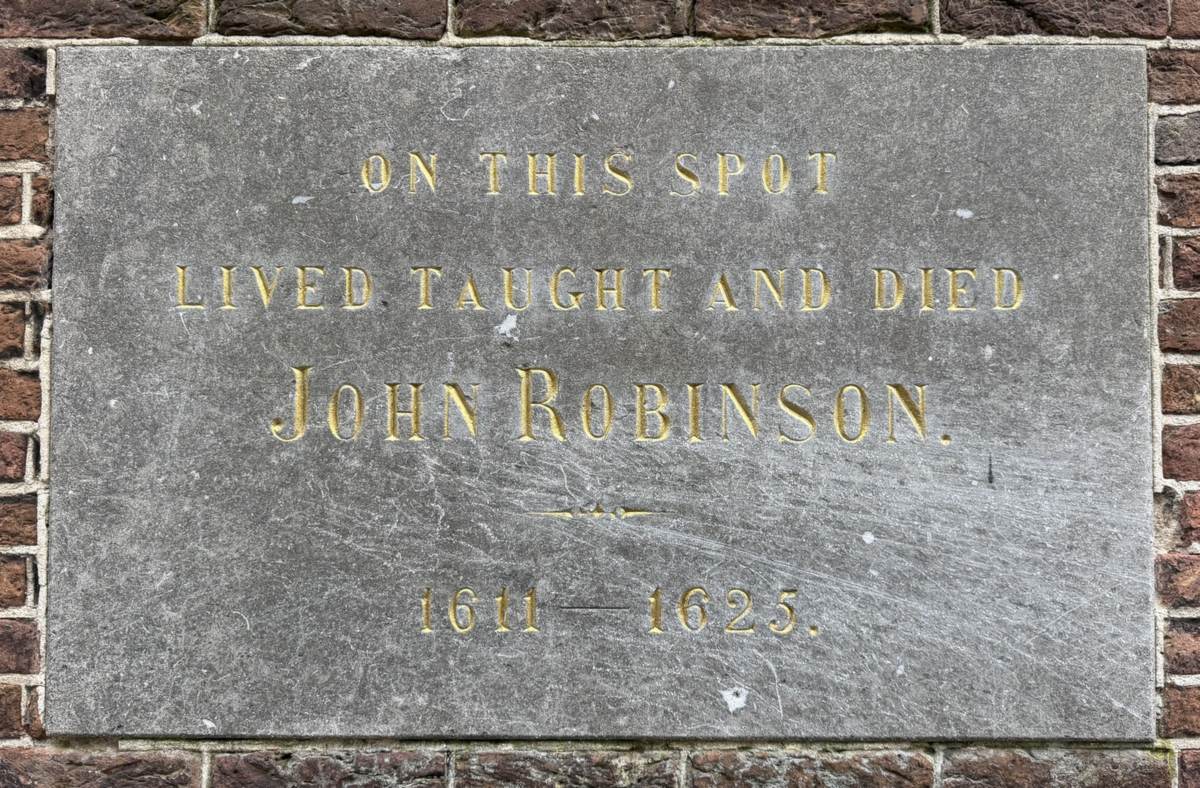
In 1609, led by John Robinson, they were given permission by the Leiden city council to settle in Leiden. In 1611 Robinson and three fellow believers bought the house called the Groenepoort (Green Gateway) on the Kloksteeg, on the site of today’s hofje. On this plot, then also known as the English Gate, the group had twenty-one small houses built.
Departure for America
The group never really settled in Leiden: between 1620 and 1630 most of the congregation emigrated to America. The first group left Delfshaven in 1620 on the Speedwell and made the crossing from England on the Mayflower. They are seen as founders of what later became the United States. On 29 August 1920, three hundred years after their departure, a group of Americans visited the Jean Pesynhof to mark the occasion, and many Americans still make a pilgrimage to Leiden today.
Misconceptions
A persistent misconception holds that the Pilgrims lived in this hofje. That is not true: their houses quickly fell into decay after they left. John Robinson himself did not make the crossing — he died in 1625 and is buried in the Pieterskerk, which is on the walking tour.

One of the Pilgrims was called Philippe de Lannoy; he was baptised in 1603 in the Vrouwekerk (Church of Our Lady), the church where Jean Pesyn and Maria de Lannoy were later buried. Here too there is a misconception: Marie de Lannoy, co-founder of this hofje (see the founders), was not his mother.